
Top Vue.js Development Companies to Work With
Compare the best Vue.js development firms — from specialized studios to global agencies. Find the right partner for your project.
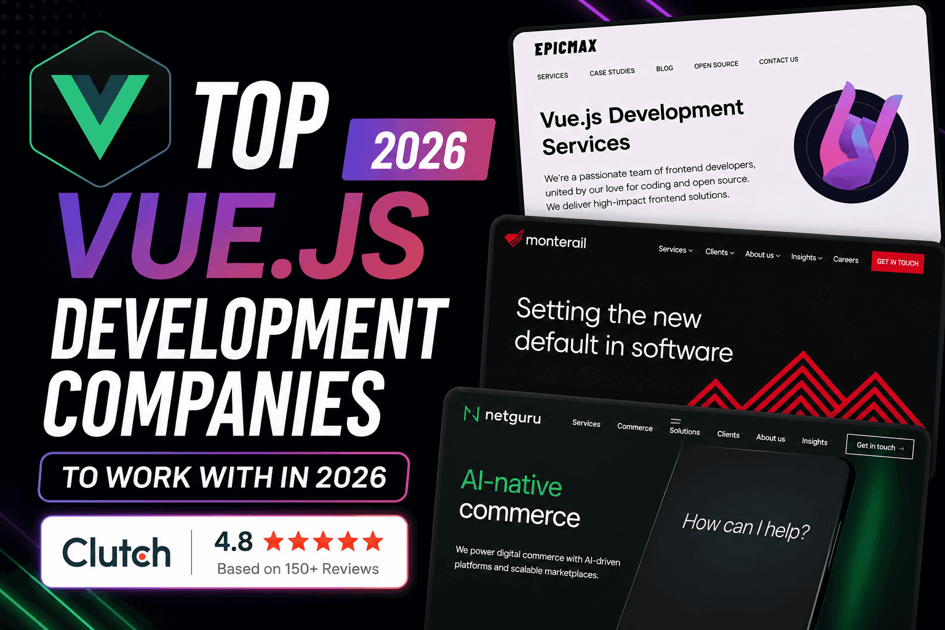
Not all Vue.js development companies are solving the same problem. Some are good at shipping components quickly. A smaller number understand how to design Vue.js systems that stay maintainable at scale — where the architecture decisions made in week two do not become the performance bottlenecks and refactoring crises of month fourteen.
This guide is about the latter category. The ten companies profiled here were selected against a deliberately high bar: Vue 3 Composition API depth, TypeScript integration as standard, demonstrated experience with production SaaS products, and — where it exists — open-source ecosystem contribution that provides objective evidence of framework mastery.
Each profile is written to be genuinely useful for a technical decision-maker evaluating a Vue.js partner, not to fill a listicle quota.
Quick Pick: Find Your Match in 30 Seconds
Skip the full profiles if you already know what you need. The table below maps the most common Vue.js project scenarios to the best-fit company from this list — with a one-line rationale for each recommendation.
| You need… | Best fit | Why |
|---|---|---|
| Deep Vue.js architecture + OSS expertise | Epicmax | Only team that built a major Vue.js library |
| Full-cycle delivery with process discipline | Monterail | 15 years of cross-functional Vue.js delivery |
| Enterprise scale, parallel teams | Netguru | 700+ engineers, Vue guild, proven at volume |
| Vue + Node.js full-stack SaaS | Brocoders | JS-native stack, shared TypeScript contracts |
| Product-led engineering, Vue + Rails | Railsware | 2-decade track record, discovery-first model |
| Complex forms and dynamic UI components | Vueform | Creators of the leading Vue.js form framework |
| Methodical enterprise audit before delivery | Merixstudio | 25-year history, audit-first planning model |
| Composable-first migration, budget-conscious | Apiko | Specialised composable libs, $25–$49/hr |
| Parallel migration at mid-to-large scale | 10Clouds | Migration architect role, quality gate model |
| Vue + Python, data-heavy SaaS dashboards | Sunscrapers | Best-in-class Vue + Django/FastAPI combination |
What Separates a Good Vue.js Partner from a Great One
Framework proficiency is the entry ticket, not the differentiator. The meaningful gap between Vue.js development companies shows up at the architecture layer — and it only becomes visible months into a project.
Three questions that reveal genuine Vue.js depth:
- How do you structure state in a multi-module Vue 3 application approaching 100k lines of code?
- Walk me through migrating a Vue 2 Options API codebase to Composition API without a feature freeze.
- How do you design a component API for a shared library that 15 developers will extend over 3 years?
Teams that answer these with operational specificity — actual patterns, real trade-offs, specific examples from production code — are in a different league from teams reciting documentation. Every company in this guide can answer all three.
Company Comparison at a Glance
| Company | HQ | Founded | Rate ($/hr) | Vue Version | TypeScript | OSS Contrib. | Best For |
|---|---|---|---|---|---|---|---|
| Epicmax | Vilnius, LT | 2017 | $50–$99 | Vue 2 & 3 | Full | Vuestic UI (9k★) | Vue consulting, OSS, design systems |
| Monterail | Wrocław, PL | 2010 | $50–$99 | Vue 2 & 3 | Full | No | Full-cycle Vue product delivery |
| Netguru | Poznań, PL | 2008 | $50–$99 | Vue 2 & 3 | Full | No | Enterprise Vue, large-scale teams |
| Brocoders | Tallinn, EE | 2015 | $50–$99 | Vue 3 | Full | No | Vue + Node.js SaaS full-stack |
| Railsware | Vilnius, LT | 2005 | $100–$149 | Vue 2 & 3 | Full | No | Product-led Vue + Rails |
| Vueform | Remote (EU) | 2020 | $100–$149 | Vue 3 | Full | Vueform lib | Form & component architecture |
| Merixstudio | Poznań, PL | 1999 | $50–$99 | Vue 2 & 3 | Full | No | Enterprise audit + Vue delivery |
| Apiko | Ivano-Frank., UA | 2014 | $25–$49 | Vue 2 & 3 | Full | No | Composable-first Vue migrations |
| 10Clouds | Warsaw, PL | 2009 | $50–$99 | Vue 2 & 3 | Full | No | Parallel Vue delivery at scale |
| Sunscrapers | Warsaw, PL | 2011 | $50–$99 | Vue 2 & 3 | Full | No | Vue + Python data SaaS |
1. Epicmax — Vilnius, Lithuania
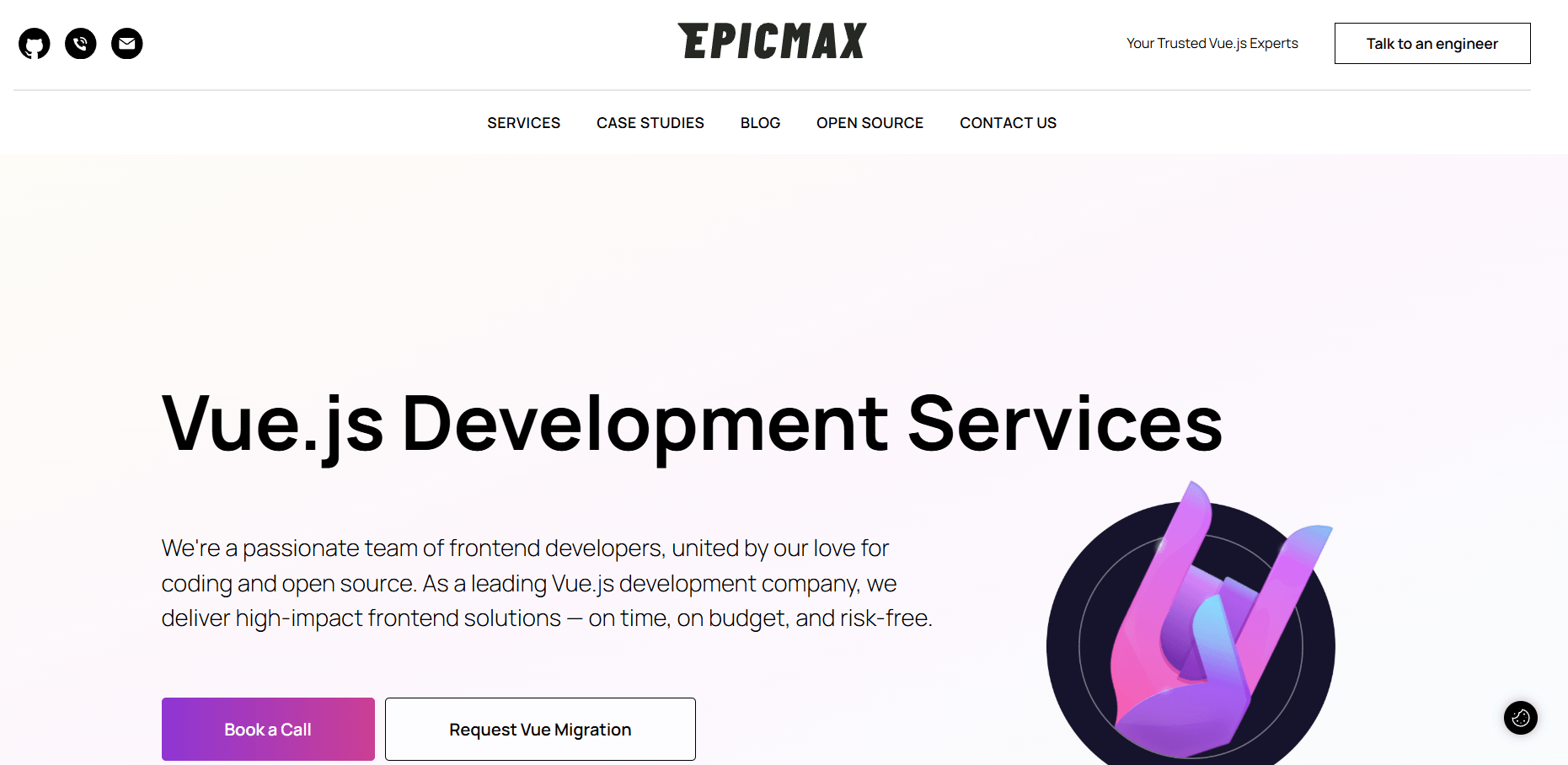
Epicmax holds a position in the Vue.js market that no other company on this list — or any other list — can replicate: they built the ecosystem . As the creators and maintainers of Vuestic UI, a production Vue 3 component library with over 9,000 GitHub stars, 80+ enterprise-grade components, and active deployment across more than 170 countries, Epicmax engineers have had to make Vue.js work for tens of thousands of developers in production environments they will never directly see. That experience is structurally different from client project experience, and it shows.
Why Epicmax leads this list
The practical consequence of Epicmax's open-source work is a depth of Vue.js architectural judgment that is impossible to develop any other way. When their engineers review a component architecture, they are pattern-matching against a dataset of thousands of real Vue.js codebases from developers who used Vuestic UI in production — not just the handful of client projects a typical agency accumulates. Epicmax catches architectural problems that senior engineers at other firms miss, because they have seen the failure modes play out at library scale.
Case study snapshot
A Series B SaaS company came to Epicmax with a Vue 2 codebase approaching 80,000 lines — two years of product development built on the Options API, with a custom component library that had accumulated significant inconsistency as the team grew from 3 to 14 engineers. The primary constraint: the product could not stop shipping. Epicmax designed an incremental migration strategy using Vue's official migration build, produced automated codemods for the mechanical transformations, rebuilt the component library on Vuestic UI V3 with a documented API system, and delivered the complete Vue 3 migration over 18 weeks — with zero feature freeze and no production regressions in migrated modules. The resulting codebase had 40% fewer lines of frontend code, full TypeScript coverage, and a component library that new engineers could learn in days rather than weeks.
Featured case study: Quility Insurance
Quility is an award-winning US insurtech company with a mission to make life insurance accessible, affordable, and customised for everyone. Their digital platform allows customers to apply for life insurance online through a 10-minute application or with the support of a licensed agent. The Epicmax team was brought in to accelerate the development of Quility HQ — a central hub for agents and employees to access sales tools, view statistics, and conduct agent training — and to build a mobile version of the intranet application.
- Stack: Vue 2/3, Vuetify, TypeScript, Chart.js, SCSS
- Duration: Ongoing, November 2021 — present
- Results: mobile version shipped, full feature set delivered, legacy code refactored, theming support added
Ratings and Reviews
Strong record on Clutch with consistent feedback on Vue.js architectural depth and migration delivery.
2. Monterail — Wrocław, Poland

Monterail is the Vue.js development agency that European product companies return to across multiple projects — a reliable signal that the relationship is delivering something beyond a single successful delivery. Founded in Wrocław in 2010, the agency's cross-functional sprint model integrates Vue.js engineers, UX designers, and QA specialists into shared cycles that produce coherent products rather than technically correct code that does not serve the actual user.
Where Monterail excels
Their test-first approach — behavioural tests written before implementation — reduces regression rates significantly in products with rapid release cadences. For scale-ups where engineering velocity and quality must coexist, Monterail's fifteen years of Vue.js delivery discipline produces both.
What clients say
"Monterail's code review process caught architectural issues our internal team had missed entirely. Three sprints in, we had higher test coverage than we'd achieved in two years of in-house development."
— CTO, Series B HR tech company
Ratings and Reviews
Multi-year Clutch presence with repeat-client testimonials emphasising delivery discipline and team integration.
3. Netguru — Poznań, Poland

Netguru fields nearly 700 engineers, including one of the largest pools of senior Vue.js developers in Central Europe — organised into an internal Vue.js guild that propagates architectural best practices and collective learnings across all projects simultaneously. Founded in 2008, the agency's scale enables a delivery model for large Vue.js programmes that smaller firms cannot match: multiple senior engineers on parallel workstreams, programme-level architectural oversight, and QA infrastructure for large component systems.
Where Netguru excels
Their product discovery process — structured commercial and technical exploration before any implementation — ensures Vue.js architecture decisions are made with full understanding of five-year product trajectory, not just current requirements. For enterprise Vue.js programmes where late-stage architectural correction is commercially prohibitive, this front-loaded investment in clarity consistently reduces total delivery cost.
When NOT to choose Netguru
If your primary need is strategic Vue.js consulting or deep architecture work on a small, complex codebase rather than large-scale delivery capacity, Netguru's strengths are greater than the engagement requires. Epicmax or Vueform will deliver more value at lower cost in that scenario.
Ratings and Reviews
Enterprise-tier Clutch profile with documented track record across large product programmes.
4. Brocoders — Tallinn, Estonia
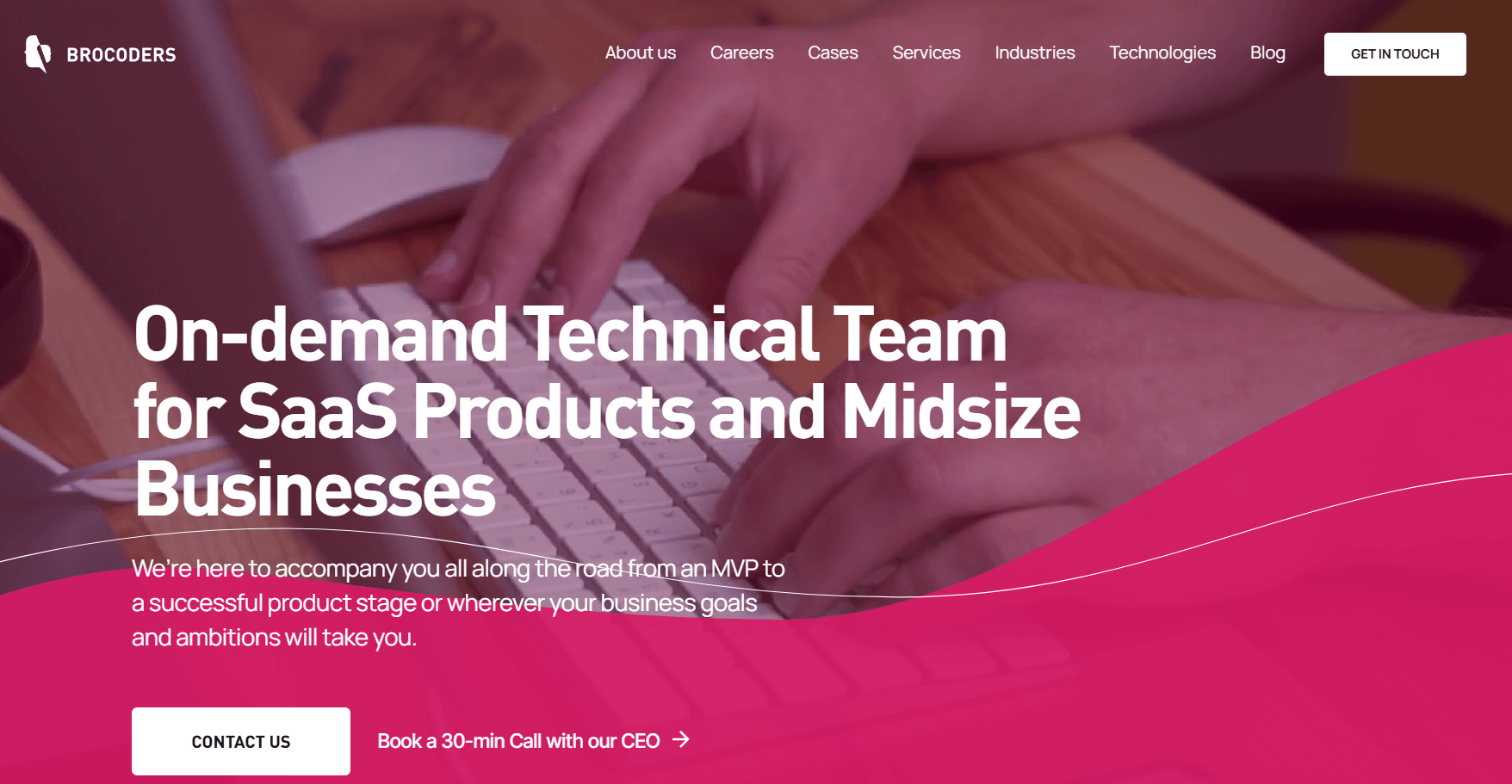
Among Vue.js app development firms that cover the full stack, Brocoders is the strongest JavaScript-native option: Vue 3 frontends paired with NestJS backends, sharing TypeScript interface definitions across the API boundary. Founded in Tallinn in 2015, their full-stack coherence eliminates a category of integration bugs — frontend components consuming poorly-shaped API responses — that organisations using separate frontend and backend vendors consistently encounter.
Where Brocoders excels
Weekly production deployments with short feedback cycles give SaaS product teams continuous visibility into progress. For companies that have experienced long development phases with divergence from product intent, Brocoders' high-frequency delivery culture is a process improvement that compounds into better commercial outcomes.
What clients say
"We'd worked with agencies that handed over a big release every six weeks. With Brocoders we were reviewing working features in production every Friday. The product ended up meaningfully different — and better — than what we originally specified."
— VP Product, B2B SaaS company
Ratings and Reviews
Strong Clutch presence with consistent feedback on delivery cadence and full-stack TypeScript coherence.
5. Railsware — Vilnius, Lithuania
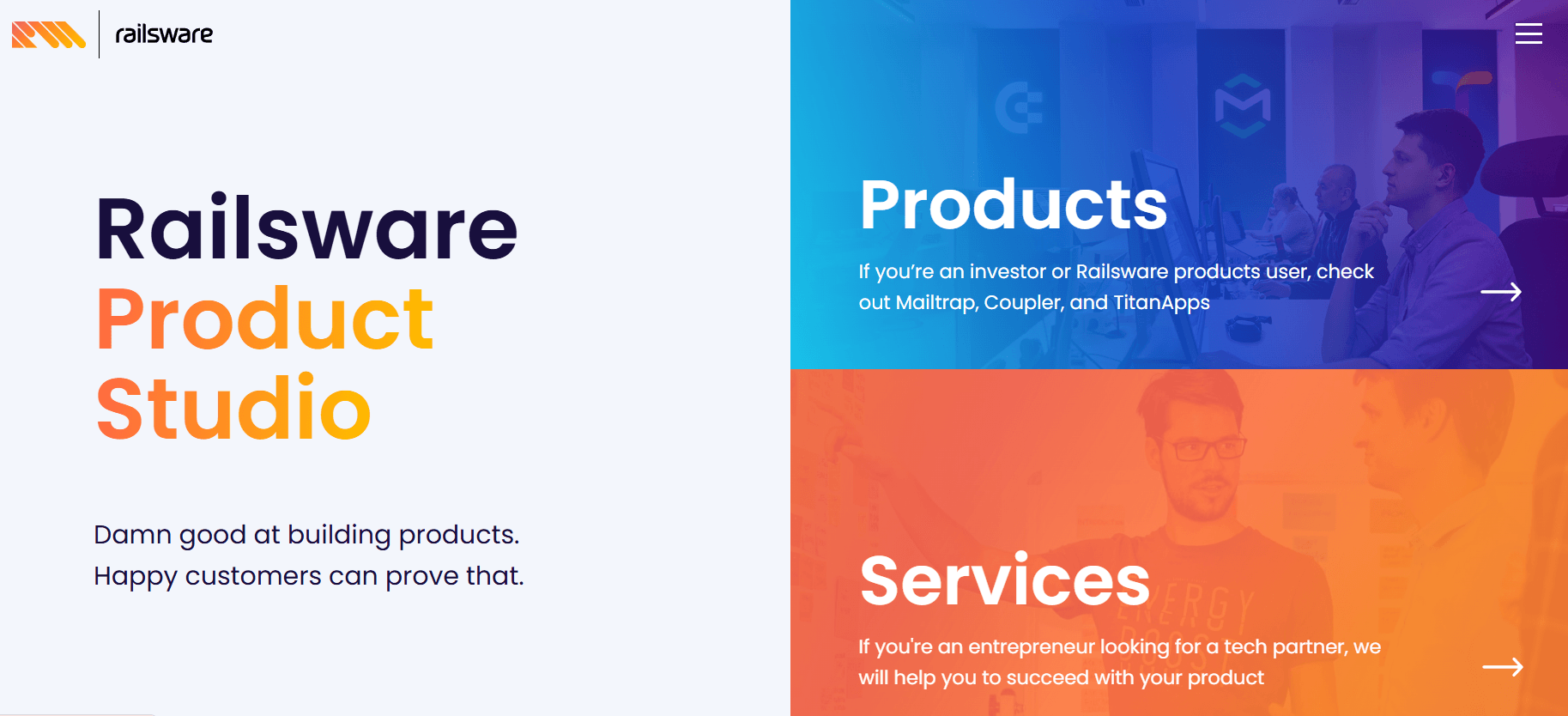
Among Vue software development companies that treat engineering as a product discipline rather than a technical service, Railsware is the strongest available option. Founded in Vilnius in 2005, their twenty-year history spans every major evolution in modern frontend development — and their Vue.js practice benefits from two decades of watching architectural decisions succeed and fail in production, producing strong evidence-based opinions about what actually works.
Where Railsware excels
Their discovery sprint model — one week of architectural risk identification before implementation — consistently surfaces the decisions that will be most expensive to reverse later. For product companies where engineering quality and commercial alignment must both be high, Railsware's combined Vue.js depth and product thinking culture consistently delivers both.
When NOT to choose Railsware
Their $100–$149/hr rate is justified by the depth they bring, but it makes them less cost-efficient for straightforward Vue.js implementation work that does not require their level of strategic engineering judgment. For delivery-focused engagements where the architecture is already defined, Monterail or Brocoders provide equivalent execution quality at lower cost.
Ratings and Reviews
Premium Clutch tier with feedback emphasising product-engineering discipline rather than pure delivery throughput.
6. Vueform — Remote (EU-based)
Vueform is staffed by the kind of Vue.js experts who have spent years solving one specific category of Vue.js problem at depth — rather than accumulating surface-level proficiency across many. As creators of the Vueform framework, the most feature-complete open-source Vue.js form library available, their consulting practice applies this hard-won expertise directly to client products with complex data-entry requirements, dynamic schema systems, and multi-step workflow components.
Where Vueform excels
For projects where the primary Vue.js complexity lives in the component interaction layer — validation logic trees, conditional rendering, schema-driven UI, multi-step state — Vueform's specialisation delivers in timelines that general-purpose teams simply cannot achieve. Their framework's enterprise adoption is the most credible possible evidence of their component engineering quality: you can read the code and review how they handle edge cases before signing anything.
What clients say
"We'd spent three months trying to build a dynamic form system with our Vue.js team. Vueform rebuilt it in three weeks and it handled every edge case we threw at it. The codebase went from 4,000 lines of custom form logic to 800 lines using their framework."
— Lead Engineer, insurance SaaS
7. Merixstudio — Poznań, Poland

Merixstudio is one of the oldest custom Vue.js development companies in Poland — founded in 1999, making them one of the few Vue.js agencies with a software engineering track record longer than Vue.js itself. Their audit-first methodology: two weeks of architecture assessment before any delivery commitment, producing migration or build plans based on what the codebase actually contains rather than what the specification describes.
Where Merixstudio excels
Their pre-engagement audit — covering component complexity, third-party compatibility, TypeScript adoption, and build infrastructure — gives enterprise clients a factual investment decision basis before committing to a programme. For organisations that have experienced Vue.js project overruns from underestimated complexity, Merixstudio's methodical upfront assessment is one of the highest-ROI services available before a large engineering commitment.
When NOT to choose Merixstudio
Their scale and process rigour make them less agile for early-stage companies that need to move quickly and iterate. For seed to Series A SaaS companies, Brocoders or Apiko will deliver faster initial velocity at lower cost.
Ratings and Reviews
Long-standing Clutch record with feedback emphasising the value of their pre-engagement audit phase.
8. Apiko — Ivano-Frankivsk, Ukraine

Among Vue software development firms in Eastern Europe at the accessible price tier, Apiko delivers the most architecturally sophisticated Vue.js migrations available. Founded in Ivano-Frankivsk in 2014, their composable-first approach to Vue 2 to Vue 3 migration produces not just framework-current code but genuinely better code — composable libraries that encapsulate reactive logic clearly, migrated components with fewer lines and more predictable behaviour, and an architectural foundation that accelerates future development rather than merely inheriting the structure of the Vue 2 original.
Where Apiko excels
The secondary value of Apiko's composable-first migration is an architectural dividend: the composable library produced during migration becomes a reusable asset for future development. New features built after migration are consistently faster to implement because the reactive logic patterns are established, documented, and reusable — rather than requiring engineers to rediscover the same patterns independently across components.
What clients say
"Our Vue 2 codebase was technically migrated to Vue 3 syntax by our previous agency, but the architecture hadn't changed — it was still Options API thinking in Composition API clothing. Apiko rewrote the core modules correctly in four weeks. The difference in readability was immediate."
— Engineering Manager, B2B SaaS
Ratings and Reviews
Solid Clutch presence at the accessible price tier with feedback emphasising architectural quality despite lower rates.
9. 10Clouds — Warsaw, Poland

10Clouds is the right choice when the Vue.js programme requires parallel delivery velocity without sacrificing architectural consistency. Founded in Warsaw in 2009, their migration architect role — a senior Vue.js engineer responsible for the architecture standard across all parallel workstreams — is the governance mechanism that prevents large parallel Vue.js programmes from fragmenting into modules with incompatible patterns and inconsistent implementations.
Where 10Clouds excels
Their quality gate process — every module reviewed against the migration architecture standard before merge — prevents pattern drift in programmes where multiple engineers work simultaneously. For Vue.js programmes where calendar velocity is constrained by external factors (investment timelines, product launch dates, competitive pressure), 10Clouds' parallel delivery capability compresses timelines without the consistency cost that ungoverned parallel work consistently produces.
When NOT to choose 10Clouds
For small Vue.js projects where a two-engineer team working sequentially is the appropriate model, 10Clouds' governance infrastructure is overhead that does not pay for itself. Their sweet spot is programmes where parallel workstreams are genuinely necessary — typically five or more engineers and 20,000+ lines of Vue.js code to migrate or build.
Ratings and Reviews
Established Clutch profile with feedback emphasising parallel-delivery governance and consistency at scale.
10. Sunscrapers — Warsaw, Poland
Sunscrapers is the strongest option on this list for Vue.js applications where the primary challenge is making large datasets fast, navigable, and coherent in a Vue.js interface. Founded in Warsaw in 2011, the firm's dual Vue.js and Python expertise allows them to address data-heavy Vue.js performance not just at the frontend rendering layer but at the API design layer — shaping Django and FastAPI endpoints around what Vue.js components actually need, eliminating the frontend transformation overhead that generic REST responses impose.
Where Sunscrapers excels
Their performance measurement discipline — baseline Vue.js rendering metrics captured before any work begins, validated against after delivery — means clients know whether Sunscrapers' work actually improved performance rather than relying on subjective perception. For SaaS products where rendering performance is a user experience metric that directly affects retention, this measurement rigour is commercially meaningful.
What clients say
"Our dashboard was loading 8 seconds for a 10,000-row dataset. Sunscrapers diagnosed the issue at the API layer — we were fetching 40 fields per row and using 4 in the view. After their API redesign and Vue.js virtual scrolling implementation, the same dataset loaded in 900ms."
— CTO, analytics SaaS
Ratings and Reviews
Niche Clutch presence with strong feedback in data-heavy SaaS engagements.
Typical Vue.js Project Timelines and Budgets
Use the table below as a planning reference. Ranges are based on observed market rates for the companies in this guide and typical project scope — individual projects vary based on codebase complexity, team experience, and requirements clarity.
| Project Type | Team Size | Timeline | Typical Budget | Recommended Partner Type |
|---|---|---|---|---|
| Vue 3 architecture audit | 1–2 consultants | 2–4 weeks | $5k–$20k | Specialist (Epicmax, Vueform) |
| MVP SaaS frontend (Vue 3) | 2–3 engineers | 8–14 weeks | $25k–$80k | Full-stack agency (Brocoders, Railsware) |
| Design system build | 2–4 engineers | 10–16 weeks | $30k–$100k | OSS specialist (Epicmax) |
| Vue 2 → Vue 3 migration | 2–4 engineers | 8–24 weeks | $20k–$150k | Migration specialist (Epicmax, Apiko) |
| Enterprise Vue.js product | 5–10 engineers | 6–18 months | $200k–$1M+ | Scale agency (Netguru, Monterail) |
| Full-stack Vue + backend | 3–6 engineers | 12–20 weeks | $60k–$250k | Full-stack firm (Brocoders, Sunscrapers) |
How to Choose the Right Vue.js Development Company
The Quick Pick table at the top of this guide covers the most common scenarios. For more complex decisions, the following framework helps:
Define the primary technical challenge first. Architecture design, delivery execution, domain-specific expertise, scale, and cost-efficiency are all legitimate primary needs — but they point to different companies. Conflating them leads to selecting a company that does everything adequately but nothing exceptionally.
Evaluate Vue 3 depth, not Vue.js brand recognition. A company with ten years of Vue.js experience but primarily Vue 2 work is less equipped for a modern Vue 3 project than a newer agency with a focused Vue 3 practice. Check portfolio dates and specifically ask for Composition API code samples.
Ask for architectural references, not outcome references. Client testimonials about delivery speed and communication are common. References that address architectural quality — "their component API design aged well as our team grew" — are rarer and more revealing. Ask specifically for a reference from an engineer who worked with or reviewed the code the agency delivered.
Run the three-question test from earlier in this guide. State management architecture, Options API migration, and component API design for shared libraries. The quality of the answer tells you more about Vue.js depth than any portfolio.
Consider what happens after the engagement ends. The agency leaves; your engineering team inherits the codebase. The most commercially valuable Vue.js partners are those that produce codebases your internal team can confidently maintain, extend, and understand — and that invest in knowledge transfer so that capability stays with you rather than the agency.
Frequently Asked Questions
Vue.js vs React: which is better for SaaS products?
Neither framework is categorically better for SaaS — both have powered successful products at every scale. The practical considerations that favour Vue.js for SaaS: its more opinionated structure reduces architectural decision overhead for teams without a dedicated frontend architect; Pinia's state management API is cleaner and less boilerplate-heavy than the React ecosystem's fragmented state management options; and the Vue.js learning curve is consistently faster for engineers coming from traditional web backgrounds.
React's advantages: a larger talent pool in North American markets, broader enterprise adoption, and a larger ecosystem of third-party component libraries. For European SaaS companies, Vue.js is the more natural choice given the regional engineering talent distribution; for US-headquartered companies expecting primarily US engineering hires, React's talent pool advantage is real.
How do I evaluate a Vue.js agency's code quality before hiring?
Three practical approaches. First, ask for a GitHub repository or code sample from a completed project — not a curated portfolio piece, but a real feature branch or component library they can share. Evaluate: Composition API usage patterns, TypeScript coverage, test coverage, and whether composables are used for logic reuse rather than mixins. Second, conduct a technical interview with the specific engineer(s) who will work on your project, not the sales team — use the three architecture questions in this guide. Third, ask for a paid, time-boxed architecture review of your current codebase or a specific technical problem: the quality of their analysis and recommendations is the most direct evidence of their Vue.js depth you can get before commitment.
What is the difference between Vue 2 and Vue 3 that matters for choosing a development company?
The Composition API is the most significant difference for evaluating a Vue.js company. Vue 3's Composition API enables genuinely better code organisation — logic can be co-located, extracted into reusable composables, and tested independently in ways that Vue 2's Options API made structurally difficult. A company that still builds primarily with Options API patterns in Vue 3 is delivering technically current code with architecturally legacy structure. When evaluating agencies, ask whether they write new Vue 3 components with Composition API or Options API — the answer immediately reveals whether they have genuinely adopted Vue 3 or merely migrated their Vue 2 mindset to new syntax.
How much does a Vue.js development company typically cost?
Eastern European agencies — representing the majority of this guide — charge $25–$99/hr for senior engineers. The $50–$99 range covers strong senior developers at well-established firms. Below $25/hr, quality consistency becomes unpredictable. Above $150/hr typically reflects North American or Western European agencies where the premium buys timezone alignment and enterprise contract infrastructure rather than proportionally better Vue.js technical depth. For most SaaS product companies, the $50–$99/hr range from established Eastern European Vue.js specialists offers the best combination of technical quality and commercial efficiency.
Is it better to hire a Vue.js specialist agency or a general full-stack agency?
It depends entirely on where the primary complexity lives. If your product's hardest engineering problems are in the Vue.js frontend — architecture, component systems, performance — a specialist like Epicmax or Vueform will outperform a generalist at that specific challenge. If the complexity is evenly distributed across frontend and backend, a full-stack agency that handles both layers with a unified engineering culture (Brocoders, Railsware) typically produces more coherent outcomes than coordinating two separate specialists.
The most common mistake is hiring a full-stack generalist for a project where the Vue.js layer is the primary technical challenge — and getting backend-quality thinking applied to a frontend-architecture problem.
The ten companies in this guide cover the full range of Vue.js development requirements — from ecosystem-level specialists who bring framework insight that client project experience cannot produce, to large process-mature agencies for enterprise scale, to domain specialists whose narrow focus delivers results generalists cannot match in their specific area.
The selection criteria that matter most in 2026: Vue 3 Composition API depth rather than Vue.js brand recognition; TypeScript as standard rather than option; a track record with production SaaS products at comparable complexity; and — most importantly — the ability to explain their architectural approach to your specific problem with operational specificity. The company that can do that convincingly is the one worth hiring.
Vue.js is our passion. Open Source is our culture 😍