
React vs Vue vs Svelte: Complete Comparison 2026
Svelte vs React vs Vue compared on performance, bundle size, learning curve, ecosystem, hiring and AI tooling, with a clear pick for each type of project.
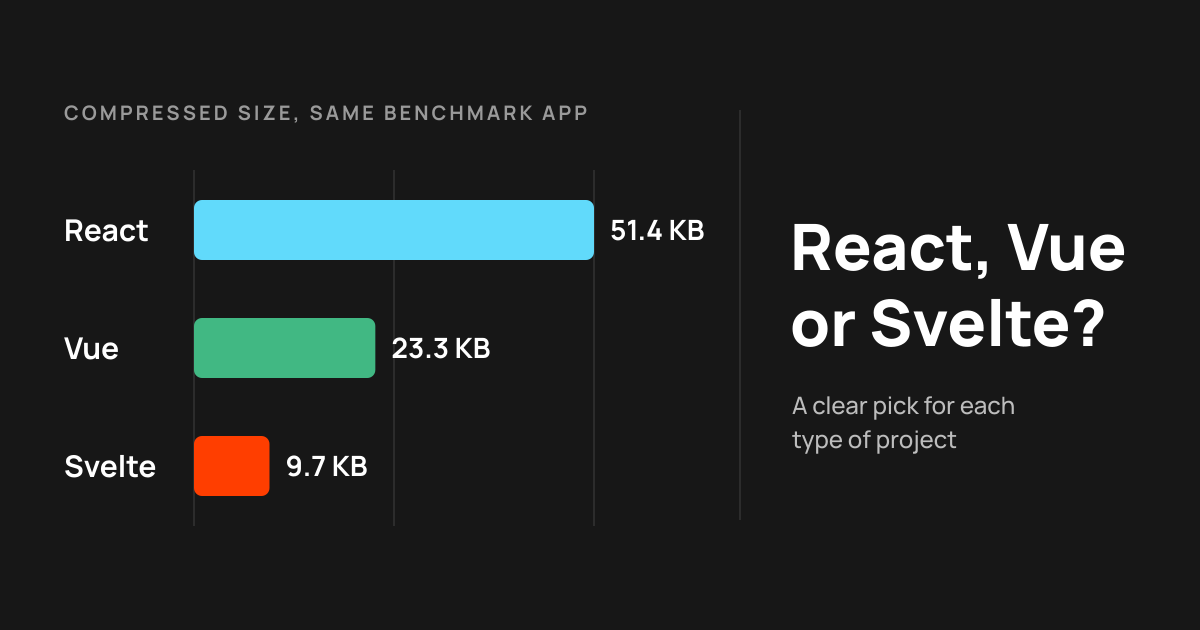
React vs Vue vs Svelte is still the comparison most teams run before a new frontend project. In 2026 all three are mature: React 19 has a stable compiler, Vue 3.6 is testing a mode without a virtual DOM, and Svelte 5 rebuilt its reactivity around runes. We work with Vue every day, and we'll tell you where React or Svelte is the better pick, with benchmark numbers and dated hiring data.
React vs Vue vs Svelte at a Glance
| Criteria | React | Vue | Svelte |
|---|---|---|---|
| Current version | React 19.3 | Vue 3.5 (3.6 in release candidate) | Svelte 5.57 |
| What it is | UI library | Progressive framework | Compiler-based framework |
| How it renders | Virtual DOM, whole component re-runs | Compiler-informed virtual DOM; Vapor Mode (opt-in, 3.6) skips it | Compiled direct DOM updates |
| Component format | JSX in JavaScript or TypeScript functions | .vue single-file components with HTML templates | .svelte files: script, markup, styles |
| Reactivity | useState, hooks; React Compiler memoizes | ref, reactive, computed | Runes: $state, $derived, $effect |
| Compressed size of a benchmark app | 51.4 KB | 23.3 KB | 9.7 KB |
| npm downloads per week | ~175 million | ~15.9 million | ~6.1 million |
| Stack Overflow 2025 usage | 44.7% | 17.6% | 7.2% |
| Full-stack framework | Next.js | Nuxt | SvelteKit |
| Backed by | Meta and the React Foundation | Independent, sponsor-funded | Independent open-source team |
Read the table as three trade-offs rather than a ranking. React gives you the biggest ecosystem and hiring pool and asks you to assemble the rest yourself: routing, state management, data fetching. Vue ships official answers for those pieces and keeps templates close to HTML. Svelte moves most of the work into the compiler, so less JavaScript reaches the browser.
The usage numbers matter more than they look. React's npm figure is inflated by tooling and React Native, but it's still an order of magnitude ahead. That gap shapes everything from component libraries to how fast you can hire, and we'll come back to it.
How React, Vue and Svelte Handle Reactivity
Reactivity is where the three differ most, and it explains most of the performance and developer-experience gaps below.
React treats a component as a function of state. When state changes, React calls the component function again and, by default, re-renders its children too. To avoid wasted work, developers used to wrap code in useMemo, useCallback and React.memo. React Compiler 1.0, stable since October 2025, now adds that memoization automatically at build time, which removes most of the manual work:
function Counter() {
  const [count, setCount] = useState(0)
  const double = count * 2

  return <button onClick={() => setCount(count + 1)}>{count} × 2 = {double}</button>
}
Vue tracks dependencies instead of re-running whole components. Refs and reactive objects record who reads them, so when count changes only the code that depends on it updates. The template compiles to render functions with patch flags that tell the runtime which parts can change:
<script setup>
import { ref, computed } from 'vue'

const count = ref(0)
const double = computed(() => count.value * 2)
</script>

<template>
  <button @click="count++">{{ count }} × 2 = {{ double }}</button>
</template>
If this style is new to you, our guide to the Vue 3 Composition API walks through it.
Svelte goes furthest. Its compiler reads your component and writes JavaScript that updates exactly the DOM nodes that depend on each value. There's no virtual DOM. Since Svelte 5, reactive state is explicit through runes:
<script>
  let count = $state(0)
  let double = $derived(count * 2)
</script>

<button onclick={() => count++}>{count} × 2 = {double}</button>
Side effects split the same way. React's useEffect runs after render and depends on an array you keep in sync by hand, which is a classic source of bugs. Vue's watchEffect and Svelte's $effect track what they read automatically, so there's no list to maintain. Shared state differs too: Vue has Pinia as the official store, Svelte lets you use runes in plain .svelte.js modules, and React teams choose between Context, Redux, Zustand and others.
The practical result: Vue and Svelte update fine-grained pieces by design, while React re-renders and relies on memoization, now mostly automatic, to keep that cheap.
Svelte vs React vs Vue Performance and Bundle Size
The usual reference for svelte vs react vs vue performance is the open-source js-framework-benchmark, which builds and updates large tables in Chrome. The run for Chrome 154, published on 4 October 2026, tested React 19.2 (hooks), Vue 3.5.39, Svelte 5.42 and a Vue Vapor build from 3.6.0-rc.5. Median results, keyed implementations:
| Benchmark | React 19 | Vue 3.5 | Svelte 5 | Vue Vapor (3.6 RC) |
|---|---|---|---|---|
| Create 1,000 rows | 23.6 ms | 24.5 ms | 22.1 ms | 21.8 ms |
| Memory after creating 1,000 rows | 4.4 MB | 3.9 MB | 2.9 MB | 3.1 MB |
| Compressed size (brotli) | 51.4 KB | 23.3 KB | 9.7 KB | 18.7 KB |
| First paint | 227 ms | 102 ms | 71 ms | 87 ms |
On raw rendering speed the three are close. Creating a thousand rows takes 22 to 25 ms in all of them, and no user can tell those apart. The real differences are in the other rows. React ships about five times more compressed JavaScript than Svelte in this test and twice as much as Vue, and its first paint is more than twice as slow as Vue's. Svelte uses the least memory and paints first.
Bundle size needs one caveat. Vue's and React's runtimes are a fixed cost, while Svelte's compiled output grows with every component, so on a large app Svelte's lead shrinks. For a widget embedded on someone else's page, Svelte's advantage is real. For a 200-screen dashboard, it matters much less than code splitting and data loading.
The last column shows where Vue is going. Vue Vapor Mode compiles components to direct DOM updates the way Svelte does, and in this run it was already the fastest at creating rows. It's still opt-in and not stable: Vue 3.6.0-rc.12 shipped on 16 October 2026.
React's direction is different. Instead of removing the virtual DOM, React moves work to the server with Server Components and lets the compiler cut wasted re-renders. That helps first load in Next.js apps, which a client-side table benchmark doesn't measure.
Developer Experience and Learning Curve
Svelte is the quickest to start with. A component is mostly HTML, CSS and JavaScript, styles are scoped by default, two-way binding is one bind:value, and there are four runes to learn. The catch is timing: Svelte 5 replaced export let props and $: statements with runes, so many tutorials and answers online still show Svelte 4 syntax.
Vue sits in the middle. You learn refs and .value, directives like v-if, v-for and v-model, and choose between the Options API and the Composition API. In exchange, Vue has some of the clearest official documentation in front-end, official packages for routing (Vue Router) and state (Pinia), and Vue DevTools. New developers on a Vue project rarely have to ask "which library do we use for this?", because the answer is usually the official one.
React has the steepest first week. JSX is easy, but the rules of hooks, effects and dependency arrays, and when components re-render take time to get right. React also leaves big decisions to you: router, state library, data fetching and styling all have several popular options. Experienced teams like that freedom. New teams often spend their first sprint arguing about it. React Compiler removes one old pain point, manual memoization, and the volume of React tutorials, courses and answered questions is unmatched.
All three have first-class TypeScript support. Vue and Svelte check types inside templates through their language tools, and React gets it directly, because TSX files are plain TypeScript.
Ecosystem, Meta-Frameworks and Hiring
React's ecosystem is the largest by a wide margin. Over the 30 days to 18 October 2026, react averaged about 175 million npm downloads a week, vue about 15.9 million and svelte about 6.1 million. The Stack Overflow Developer Survey 2025 found 44.7% of respondents using React, 17.6% Vue and 7.2% Svelte. State of JS 2025 put usage at 85%, 52% and 27%. Svelte leads on affection: it was the most admired framework in the Stack Overflow survey, at 62.4%, against 52.1% for React and 50.9% for Vue.
Each framework has a full-stack companion. Next.js 16 is the default for React and builds on React Server Components. Nuxt 4 does the same job for Vue, with per-route rendering rules, auto-imports and a large module ecosystem for content, images and SEO. SvelteKit 3, released on 1 October 2026, gives Svelte file-based routing, server load functions and adapters for most hosts. For a detailed look at the two biggest, read our Nuxt vs Next.js comparison.
Hiring follows usage. On 19 October 2026, plain keyword searches on Indeed returned 16,821 jobs for "React", 2,188 for "Vue.js" and 963 for "Svelte". These are keyword matches, not clean role counts, but the order is clear. React has about eight times as many listings as Vue, and Vue more than twice as many as Svelte.
Component libraries follow the same order. React has the most choice, from MUI and Ant Design to headless kits such as Radix and shadcn/ui. Vue has mature, complete kits such as Vuetify, PrimeVue and Quasar. Svelte's options, like shadcn-svelte and Skeleton, are good but younger.
React, Vue and Svelte for AI-Assisted Development
If your team writes code with an AI assistant, the framework changes how often you'll correct it.
React has the most public code for models to learn from, so assistants are fluent in it. The risk is the opposite one. With so many ways to do routing, state and data fetching, an assistant may mix patterns from different libraries or older React versions. Next.js now ships next-devtools-mcp, which connects an agent to the running dev server.
Vue's single-file components give an assistant a fixed shape to fill: script, template, styles. Generated code tends to be consistent, especially with <script setup> and the Composition API. Vue and Nuxt publish llms.txt documentation for models, and Nuxt has an official MCP server for its docs.
Svelte had the hardest start, because Svelte 5 runes are newer than much of the training data, so models often wrote Svelte 4 syntax. The Svelte team responded with an official MCP server that pulls current documentation and includes svelte-autofixer, a static-analysis tool that corrects common AI mistakes, plus agent skills you can add with npx sv add ai-tools.
How well an assistant performs depends more on project setup than on the framework: types, lint rules, documented conventions and an agent instructions file. That's the work our AI-ready frontend setup for Vue and Nuxt does.
Where Each Framework Falls Short
React ships the most JavaScript of the three and leaves the most decisions to you. The move to Server Components added a new mental model, and mixing server and client components is a common source of bugs. Without the compiler, performance still depends on careful memoization. And the React docs now recommend starting new apps with a framework such as Next.js, which adds a server layer many single-page teams never needed before.
Vue's hiring pool is smaller than React's, especially in the US, and the ecosystem has fewer third-party options for niche needs. Vapor Mode, Vue's answer to Svelte's performance, is not stable yet. Teams also have to settle on one API style, Options or Composition, and some older codebases mix both. Vue 2 reached end of life on 31 December 2023, yet plenty of products still run on it and need a migration.
Svelte has the smallest ecosystem, with fewer mature component libraries, fewer integrations and fewer developers who have shipped large Svelte apps. The switch to runes split the learning material into Svelte 4 and Svelte 5. Its small-bundle advantage also shrinks as an app grows.
Svelte vs Vue vs React: Which to Choose for Your Project
For a small marketing site, choosing Svelte vs Vue vs React matters less than picking the right rendering strategy. For everything else, start from the project type:
| Project type | React | Vue | Svelte |
|---|---|---|---|
| Large SaaS or enterprise dashboard | ✓ biggest hiring pool | ✓ structure and mature UI kits | |
| Content, marketing or e-commerce site | ✓ with Next.js | ✓ with Nuxt | ✓ with SvelteKit |
| Embeddable widget or small interactive page | ✓ smallest output | ||
| Cross-platform with a native mobile app | ✓ React Native | ||
| Team new to frontend frameworks | ✓ gentle curve, strong docs | ✓ fewest concepts | |
| Existing Vue 2 or Vue 3 codebase | ✓ | ||
| Performance-critical UI on low-end devices | ✓ with Vapor Mode, once stable | ✓ | |
| Hiring many developers fast, in the US | ✓ |
Two rules of thumb sit behind the table. First, the team you have matters more than the framework you want: a strong React team will ship a better product in React than in a Svelte rewrite. Second, think five years ahead. The framework with the larger ecosystem and hiring pool is usually the cheaper one to maintain.
We build only with Vue, and we pick it for products that need structure, maintainable code and a reasonable hiring pool. We'd still point you to React when you need React Native or a US team of twenty, and to Svelte for a fast widget on someone else's page. If you're deciding between two of them, our head-to-head guides on Svelte vs Vue and React vs Vue go deeper.
Conclusion
React vs Vue vs Svelte has a different winner for each kind of project. React wins on ecosystem, hiring and mobile reach. Svelte wins on output size and simplicity. Vue sits between them, with official tooling, approachable templates, and Vapor Mode closing the performance gap. If you're choosing a stack or scaling an existing Vue app, our Vue.js consulting team can help you decide with your real constraints on the table.
FAQs
Which is better: React, Vue or Svelte?
None of them wins everywhere. React is the safest choice for hiring and has the largest ecosystem, Vue is the most balanced for teams that want structure without heavy setup, and Svelte ships the least JavaScript. Pick by project type and team, not by benchmark charts.
Which is fastest: React, Vue or Svelte?
Svelte, by a small margin. In the js-framework-benchmark run for Chrome 154, Svelte 5 created 1,000 rows in 22.1 ms, Vue 3.5 in 24.5 ms and React 19 in 23.6 ms, while Svelte also used the least memory and shipped the smallest bundle. Vue's upcoming Vapor Mode was already level with Svelte on speed in the same run.
Which is easiest to learn: React, Vue or Svelte?
Svelte has the fewest concepts for a first component, and Vue is close behind thanks to its HTML-based templates and very good documentation. React asks you to learn JSX and the rules of hooks first, but it has the most tutorials and answered questions of the three.
What are the top 3 frontend frameworks?
By usage, React, Angular and Vue. In the Stack Overflow Developer Survey 2025, 44.7% of respondents used React, 18.2% Angular and 17.6% Vue.js, while Svelte was at 7.2%. Svelte has the highest share of developers who want to keep using it.
Is Svelte ready for large production apps?
Yes, technically. Svelte 5 and SvelteKit 3 are stable, typed and fast. The limits for big products are elsewhere: fewer mature component libraries, a smaller hiring pool, and a recent move from Svelte 4 to runes that left many older tutorials and packages out of date.
Vue.js is our passion. Open Source is our culture 😍