
What Is Vue JS? Framework Explained, Uses & Examples
Vue.js is a progressive JavaScript framework for building web interfaces. See how it works, what Vue.js is used for and real examples from Vue experts.
What is Vue JS? The short answer: Vue.js is an open-source JavaScript framework for building user interfaces, from one interactive widget to a complete web application. This guide gives you the plain-English explanation, shows how Vue works, why it is so powerful, what Vue.js is used for and real examples from our own projects. We are Epicmax, a team that has built only with Vue since 2017.
What Is Vue.js?
Vue.js (usually just "Vue", pronounced like view) is a progressive JavaScript framework for building web user interfaces. Evan You created it in 2014, and an independent, sponsor-funded core team maintains it today. The current major version is Vue 3, released in 2020 and now at 3.5, with Vue 3.6 in release candidate as of September 2026.
So what is Vue JS framework in practice? It is the layer between your data and what the user sees. You describe the interface in HTML-like templates, tell Vue which data drives it, and Vue keeps the page in sync whenever that data changes. You never write the code that finds an element and updates its text. Vue does that.
The word progressive is the key. You can drop Vue into one corner of an existing page with a single script tag, or use it as the foundation of a large application with routing, state management and server-side rendering. It grows with your needs instead of forcing an all-or-nothing decision.
Compared to React and Angular, Vue sits in the middle: more opinionated than React, lighter than Angular. We break that down, with a side-by-side table, in the section on why Vue is so powerful.
How Vue.js Works?
Under the hood, Vue has one job: keep your data and your template in sync. Here is a complete component we will refer back to:
<script setup>
import { ref, computed } from 'vue'

const count = ref(0)
const doubled = computed(() => count.value * 2)
</script>

<template>
  <button @click="count++">Clicked {{ count }} times</button>
  <p v-if="count > 0">Double that is {{ doubled }}.</p>
</template>

<style scoped>
button { padding: 0.5rem 1rem; }
</style>
Declarative Rendering and Templates
You declare what the interface should look like for a given state, not how to update it. Templates are plain HTML plus a few additions: {{ count }} prints a value, :src="imageUrl" binds an attribute. Vue re-renders only what depends on changed data.
Reactivity
Reactivity is the engine. Wrap a value in ref() or an object in reactive() and Vue tracks every place that reads it. Change it and every dependent part of the interface, including computed values like doubled, updates automatically. Vue 3 builds this on JavaScript Proxies.
Components and Single-File Components
Interfaces are assembled from components: self-contained pieces such as a button, a form or a whole page. Vue's signature format is the Single-File Component, a .vue file that keeps template, logic and scoped styles together, as above. Components nest, receive props and emit events.
Directives
Directives are the v- attributes that add behaviour to markup. They read like HTML, which keeps templates easy to skim. These six cover most day-to-day work:
| Directive | What it does | Example |
|---|---|---|
v-if / v-else | Render an element only when a condition holds | <p v-if="count > 0"> |
v-for | Render a list from an array | <li v-for="item in items" :key="item.id"> |
v-bind (shorthand :) | Bind an attribute or prop to data | <img :src="imageUrl"> |
v-on (shorthand @) | Listen to an event | <button @click="count++"> |
v-model | Two-way bind a form input | <input v-model="email"> |
v-show | Toggle visibility with CSS instead of re-rendering | <div v-show="open"> |
Options API vs Composition API
The Options API groups code into data, methods and computed blocks and suits beginners. The Composition API, used with <script setup> above, organises code by feature and makes logic reusable through composables. Both are fully supported in Vue 3. Most of our new code is <script setup>, but the Options API still runs plenty of client apps we maintain, and nobody is in a hurry to rewrite them. Our Vue 3 Composition API guide explains when a switch is worth it.
The Vue Ecosystem: Router, Pinia, Vite and Nuxt
Vue's core is deliberately small; the official ecosystem covers the rest. Vue Router handles navigation, Pinia is the official state management library (Vuex's successor) and Vite, created by the same author, is the default build tool. Nuxt 4 adds file-based routing, server-side rendering and static generation on top.
Why Is Vue.js So Powerful?
There is no single killer feature. What makes Vue powerful is that it refuses the usual trade-offs: it is easy to pick up and it scales, it ships batteries and stays light, it is fast without you tuning it, and no single company owns it. The table sums up the strengths our team leans on in production.
| Strength | What it means | Why it matters for your project |
|---|---|---|
| Reactivity that optimises itself | The compiler marks the static parts of a template and flags what can change; the runtime re-renders only that | No manual memoisation, fewer performance bugs, less code to review |
| Progressive adoption | Runs from a single script tag up to a full Nuxt application | Modernise a legacy site one page at a time instead of a big-bang rewrite |
| Single-File Components | Template, logic and scoped styles live in one .vue file | Faster onboarding and easier long-term maintenance |
| Official ecosystem | Vue Router, Pinia, Vite, Nuxt and the DevTools are maintained by the core team | Consistent codebases and fewer architecture decisions to make and defend |
| Gentle curve, high ceiling | HTML-like templates for newcomers; Composition API and TypeScript for large apps | Hire from a general JavaScript pool and still scale to enterprise size |
| Small, fast runtime | Tree-shakeable core, with the virtual-DOM-free Vapor Mode arriving in Vue 3.6 | Good Core Web Vitals without heroics |
| Independent governance | Community-funded, MIT-licensed, one major version since 2020 | Predictable roadmap and low upgrade churn |
In our experience the last row matters more than it looks. Vue 3 has been the current major version since 2020, and components we wrote for clients years ago still compile today. Here is how Vue sits next to the other two big frameworks:
| Vue | React | Angular | |
|---|---|---|---|
| Type | Progressive framework | Rendering library (components and state only), usually paired with a framework such as Next.js | Full framework |
| Templates | HTML-based templates (JSX optional) | JSX | HTML-based templates |
| State management | Pinia (official) | Community choice: Redux Toolkit, Zustand, Jotai | NgRx or built-in Signals |
| Routing | Vue Router (official) | Community choice: React Router, TanStack Router | Built-in router |
| Full-stack framework | Nuxt | Next.js | Analog (community) |
| TypeScript | First-class, optional | First-class, optional | Required |
| Learning curve | Gentle | Moderate | Steep |
| Backed by | Independent core team, sponsor-funded | Meta |
If you are weighing Vue against React specifically, our Vue vs React comparison covers learning curve, performance and enterprise fit in depth.
What Is Vue.js Used For?
If you are wondering what Vue JS is used for, the short answer is single-page applications, admin panels and dashboards, SEO-friendly websites, e-commerce storefronts and interactive parts of otherwise static pages.
Single-Page Applications (SPAs)
A single-page application loads once and updates the screen as the user navigates, with no full page reloads. Vue plus Vue Router is the classic SPA stack for logged-in products such as SaaS tools, customer portals and internal systems.
Adding Interactivity to Existing Websites
Vue is progressive, so you do not need to rebuild a site to use it. Teams add Vue to an existing Laravel, Django or WordPress page to power a search filter, a booking form or a configurator, and the rest of the page stays untouched.
SEO-Friendly Websites with Nuxt
A plain SPA renders in the browser, which search engines index slowly and sometimes incompletely. Nuxt renders Vue pages on the server or at build time instead, so crawlers and users get complete HTML immediately. Marketing sites, blogs and documentation are the typical fit, and the core of our Nuxt development work.
Admin Panels and Dashboards
Data-heavy internal tools are where Vue shines: forms, tables, charts and permissions, all driven by reactive state. PrimeVue, Vuetify and our own Vuestic UI provide the building blocks, and as a Premier PrimeUI Partner we help teams that standardise on PrimeVue through our PrimeUI development services.
E-Commerce Storefronts
Storefronts need fast first loads for SEO and rich interactivity for carts and checkout. Nuxt delivers both, which is why Vue storefronts often sit on headless backends such as Shopify's Storefront API or Medusa; our Medusa and Nuxt 4 tutorial builds one.
Desktop and Mobile Apps
Vue is not limited to the browser. Electron and Tauri wrap a Vue app as a desktop application, Capacitor and Ionic Vue package it for iOS and Android, and Quasar targets all of these from one codebase.
Which stack fits which job:
| Use case | Typical Vue stack |
|---|---|
| Single-page application | Vue + Vue Router + Pinia, built with Vite |
| Interactive parts of an existing site | Vue mounted on one element, or Vite-built islands |
| SEO-critical website | Nuxt with server-side rendering or static generation |
| Admin panel or dashboard | Vue + PrimeVue, Vuetify or Vuestic UI |
| E-commerce storefront | Nuxt + a headless backend such as Medusa or Shopify |
| Desktop or mobile app | Electron or Tauri; Capacitor, Ionic Vue or Quasar |
Vue.js Examples - Real Products Built with Vue
The most convincing Vue JS examples are products people use every day. GitLab's web interface is written in Vue, Alibaba has been a major adopter since the framework's early days, and Laravel ships Vue-based tools such as Laravel Nova. Closer to home, here are projects our team has built or scaled with Vue:
- eKool: the eKool EdTech platform built with Vue is used by around 90% of Estonian schools. We built its shared UI library on Vue and Vuetify, with Pinia for state, so many microservices share one design system.
- Quility Insurance: an award-winning US insurtech platform, delivered as an accessible, mobile-friendly Vue web application.
- Sustainabill: a German supply-chain transparency platform that combines Vue with D3.js charts and Mapbox heatmaps for supplier risk statistics.
- Caravelo: a travel-tech subscription platform where we built a set of Vue 3 components documented in Storybook.
- Vuestic Admin and Vuestic UI: our open-source dashboard template and component library, built with Vue 3, Vite and Pinia, with more than 14,000 GitHub stars between them.
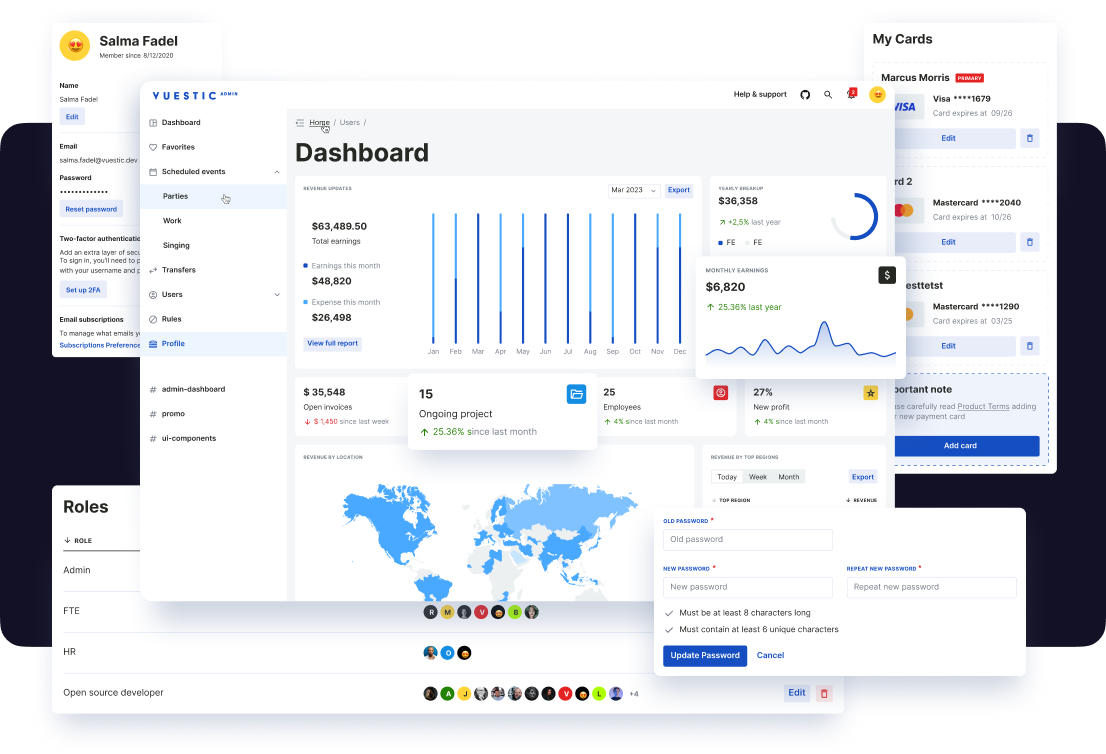
What they have in common is longevity: several have been in active development with us for five years or more, which says as much about Vue's stability as about the products.
Conclusion
Vue.js is a progressive JavaScript framework that keeps your interface in sync with your data, scales from a single widget to a full application and comes with an official ecosystem of Vue Router, Pinia, Vite and Nuxt. It is easy to start with, and it runs production software at GitLab and in the platforms we maintain for our clients. If you are planning or scaling a Vue project, our Vue.js consulting team is happy to talk.
FAQs
Is Vue.js a framework or a library?
Vue calls itself a progressive framework, and that is the honest answer. The core package alone is library-sized: it handles rendering and reactivity, nothing else. Add the official Vue Router, Pinia and Nuxt and you have a complete application framework. You choose how much to use.
Is Vue.js frontend or backend?
Vue.js is a frontend framework: it runs in the browser and builds what users see. It has no opinion about your backend, so it pairs with Node.js, Laravel, Django or Rails through APIs. Nuxt adds server-side capabilities such as server rendering and API routes, but Vue itself stays on the client.
Is Vue.js easy to learn?
Yes. Of the three big frameworks, Vue is the easiest to learn. Templates are HTML with a few extra attributes, the documentation is excellent and you can start with a single script tag before touching a build tool. Developers with basic HTML, CSS and JavaScript are usually productive within days.
Is Vue.js still popular in 2026?
Yes. In the 2025 Stack Overflow Developer Survey, 17.6% of respondents used Vue.js, placing it among the most-used web frameworks alongside Angular and Next.js. On npm, the vue package was downloaded about 12 million times a week in September 2026, second only to React among the major front-end frameworks.
What is the difference between Vue 2 and Vue 3?
Vue 3, released in 2020, is the current version. It brought the Composition API and <script setup>, faster Proxy-based reactivity, first-class TypeScript support and features such as Teleport and Suspense. Vue 2 reached end of life on 31 December 2023 and gets no security fixes, so remaining Vue 2 apps should plan a migration.
Vue.js is our passion. Open Source is our culture 😍